

"If you were to come again, you would have to be burned."
— The Grand Inquisitor to Christ, Dostoevsky's The Brothers Karamazov
Religion & Belief Systems
Where truth becomes heresy, reformers become inquisitors, and institutions crucify what they worship.
Religious institutions offer the clearest historical record of PIs in action. Not because religion is uniquely flawed, but because it's exceptionally well-documented. Centuries of written records show the same structural patterns repeating across cultures, denominations, and belief systems.
The paradox: Systems built to preserve truth systematically destroy those who embody it.
The Jesus Paradox
The Pattern
- Jesus violates the norm → gets crucified
- His teaching becomes the new norm
- Next Jesus must violate this norm (otherwise he wouldn't be Jesus)
- Institution crucifies him (to protect his teaching)
Why It's a PI
Authentic succession structurally requires betrayal. The institution cannot do otherwise—it protects what the first Jesus taught. Against the second, who does the same thing.
Dostoevsky's Grand Inquisitor understood this perfectly. Christ returns to 16th century Seville during the Inquisition. Performs miracles. The Grand Inquisitor arrests him immediately.
Why? Because Christ's presence threatens the institution built in his name. The Church has spent 1,500 years creating structure, hierarchy, certainty. Christ brings freedom, ambiguity, direct connection to God—everything the institution had to eliminate to function.
The Inquisitor doesn't hate Christ. He protects Christ's legacy. By imprisoning Christ.
All are guilty. None are at fault.
Modern Variants
- Technology: Every disruptive innovation becomes the incumbent that fights the next disruption (Microsoft vs. Open Source → Microsoft buys GitHub)
- Science: Kuhn's paradigm shifts—each revolution becomes the dogma that blocks the next revolution
- Politics: Every liberation movement becomes the new apparatus of oppression
The Trap
You cannot "learn" from the Jesus Paradox. Because "learning" would mean: keep the norm flexible. But flexible norms aren't norms. So the structure must repeat.
The Grand Inquisitor knows this. Christ knows this. That's why he says nothing.
He just kisses the old man and leaves.
Galileo and the Moving Earth
The Setup
Galileo observes reality. Earth moves around the sun. Church doctrine says otherwise. Galileo presents evidence.
Church demands he recant.
Why It's a PI
The Church cannot accept the evidence without undermining its authority. Its legitimacy rests on interpretive monopoly—the exclusive right to say what is true.
If the Church admits error on cosmology, what else might be wrong? Theology? Doctrine? The entire structure of authority?
Galileo's evidence isn't the problem. The structural threat is.
The Outcome
Galileo recants. House arrest. Legend says he muttered "Eppur si muove" (And yet it moves) afterward.
Doesn't matter. The Earth moved before his observation. Moves after his recantation. Truth exists independent of institutional permission.
The Church knew this. Galileo knew this. The performance was mandatory anyway.
The Pattern
When evidence threatens structure, structure attacks evidence. Not because the institution is evil. Because structure preserves itself. The truth can wait.
In 1992—359 years later—the Vatican admitted Galileo was right.
The Earth kept moving the entire time.
Lesson
Some battles you can't win inside the structure. The structure isn't designed to accommodate truth that threatens it. So truth goes underground, moves sideways, waits.
"Eppur si muove."
Reformation → Orthodoxy
The Cycle
Luther splits the Church for freedom of conscience. Within decades, Protestantism becomes the new orthodoxy.
Calvin burns Servetus at the stake—for theological disagreement. The Reformation, fighting dogma, creates new dogma.
Why It's a PI
Reform requires institutional structure to sustain itself. Structure requires rules. Rules become rigid. Rigidity is what you reformed against.
The pattern doesn't break because you had good intentions. The pattern reproduces through structure.
The Repetition
- Pietism rebels against Lutheran orthodoxy → becomes rigid pietist orthodoxy
- Evangelicalism rebels against mainline rigidity → becomes rigid evangelical orthodoxy
- Non-denominational churches rebel against denominational structure → create new structural patterns
Each wave thinks: "This time will be different. We learned from their mistakes."
The structure hasn't changed. Neither does the outcome.
The Trap
You cannot institutionalize freedom without limiting freedom. The moment you create rules for "how to be free," you've created the next cage.
Every reformer becomes the next guardian. Every revolution becomes the next establishment. The role changes. The structure remains.
The Heresy Mechanism
How It Works
- Individual sees truth the institution doesn't recognize
- Individual speaks truth
- Institution labels it heresy
- Individual gets punished (exile, execution, excommunication)
- Institution absorbs the idea decades/centuries later
- Calls it orthodoxy
Historical Examples
- Joan of Arc: Burned as heretic (1431), canonized as saint (1920)—489 years later
- Meister Eckhart: Condemned for mysticism, later recognized as profound Christian theologian
- Origen: Early Church Father, later condemned, now studied respectfully
- Teilhard de Chardin: Silenced by Vatican, now influential in Catholic thought
Why It's a PI
The institution needs prophets to survive long-term. But prophets threaten institutional stability short-term.
Structure optimizes for stability. Prophets are destabilizing. So structure eliminates prophets. Then absorbs their ideas once they're safely dead and can't challenge authority anymore.
The Prophet's Dilemma
- Stay silent → truth dies with you
- Speak truth → you die, truth eventually survives
Both options guarantee personal loss. The structure wins either way.
The Pattern
Truth that threatens the institution today becomes the institution's foundation tomorrow. But only after the truth-teller is gone.
The institution isn't hypocritical. It's structurally conservative. New truth must be processed, domesticated, stripped of its dangerous edges before it can be integrated.
That takes time. Usually a lifetime. Often several.
Meanwhile, the heretic burns.

Schism Dynamics
The Logic
Disagreement becomes unbearable. Split seems like the solution.
"We'll form our own church. Do it right this time."
What Actually Happens
Both sides now have:
- The same structural incentives
- The same need for institutional legitimacy
- The same pressure to enforce orthodoxy
- The same tendency to punish dissent
Plus: mutual hostility that fuels both sides' internal cohesion.
Examples
- East-West Schism (1054): Catholic and Orthodox churches split. Both claim universal truth. Both persecute heretics. Both accumulate the same structural rigidities.
- Protestant Reformation: Doesn't end with two churches. Hundreds. Each claiming correct interpretation. Each enforcing its version.
- Every subsequent split: Methodists, Baptists, Pentecostals, on and on. Same pattern. New names.
Why It's a PI
Splitting doesn't solve structural problems. It duplicates them.
You now have two versions of the same dysfunction. Both convinced they escaped the trap. Both caught in it.
The Multiplication Effect
Each schism thinks: "They were wrong. We're right."
Structure doesn't care about content. It cares about survival.
Give it a generation. The new church looks like the old church. Because the structure is the same.
The Trap
You cannot escape structure through division. You can only multiply it.
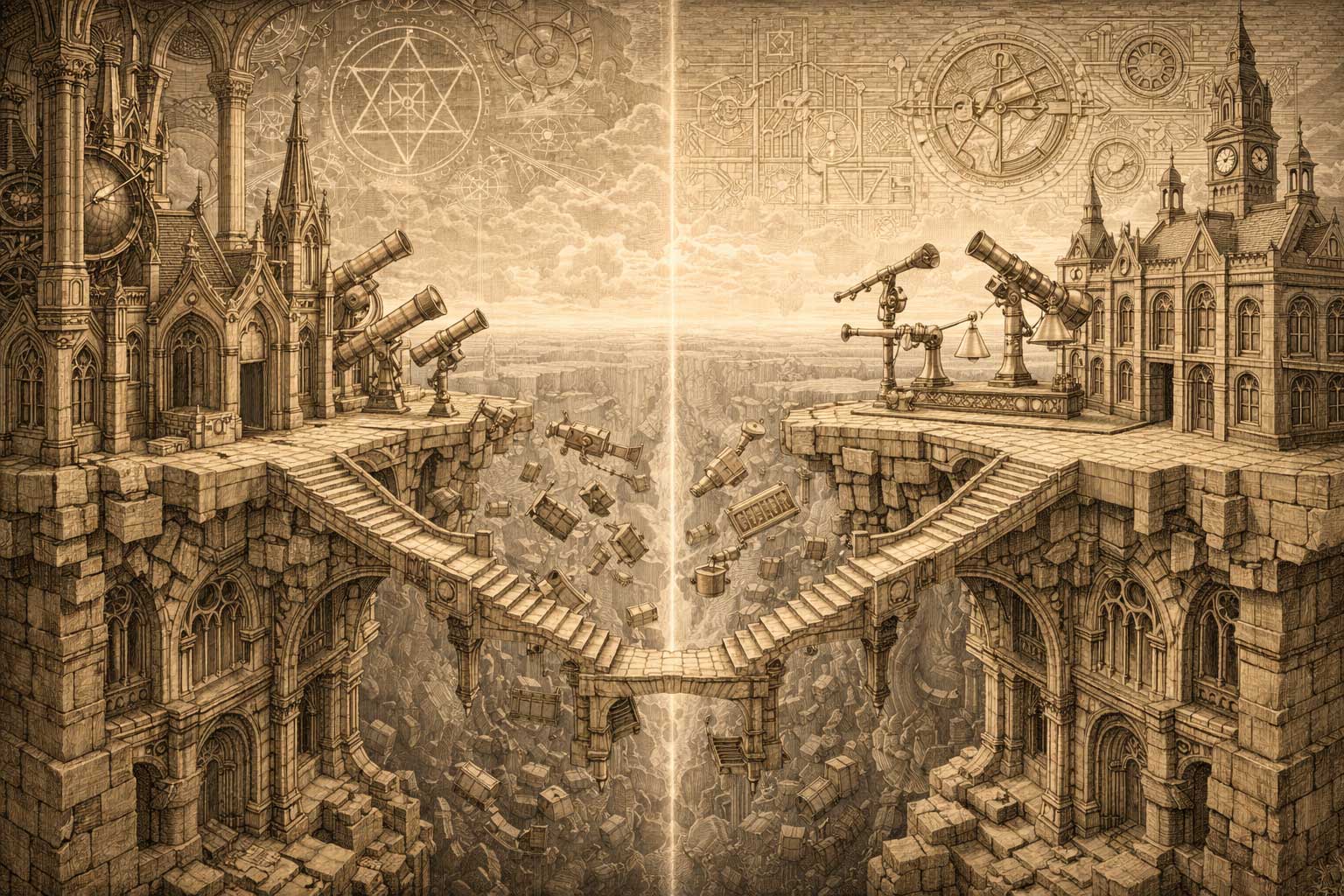
Belief vs. Unbelief
The Structure
Belief claims: Truth exists beyond empirical evidence. Unbelief claims: Only empirically verifiable claims are true.
Both positions are internally coherent. Neither can structurally convince the other.
Why Each Actor Is Rational
- Believers: Have experiences they consider real (revelation, transcendence, encounter). These aren't reducible to empirical evidence. To demand proof would destroy faith. Faith proven becomes knowledge, not faith.
- Unbelievers: Demand verifiable evidence. Not malicious—epistemological consistency. Accepting claims without evidence means accepting arbitrary claims about anything.
Why It Collectively Fails
Proving faith annihilates faith. It would be knowledge, not belief. Disproving faith is structurally impossible. You cannot prove non-existence.
Each side uses criteria the other fundamentally cannot accept. Dialogue becomes mutual contempt disguised as conversation.
The Trap
- For Believers: The more they try to "prove," the weaker the faith becomes. Apologetics is capitulation to foreign standards. Trying to convince reveals: You don't believe strongly enough yourself.
- For Unbelievers: The more energy invested in refutation, the more it confirms relevance. Why expend effort disproving something non-existent? The obsession betrays: You're not as certain as you claim.
The Pattern
Both sides trapped in discourse that structurally cannot resolve. Every attempt to convince weakens your own position.
The believer who argues proves doubt. The unbeliever who argues proves concern.
Structure wins. Conversation loses.
What Doesn't Work
- Debate → strengthens tribalism
- Evidence demands → category error (faith isn't empirical)
- Faith demands → epistemological chaos (accept anything)
- Common ground → doesn't exist at foundational level
- Mutual respect → possible, but rare, requires abandoning conversion
What Might Navigate
Stop trying to convince. The structure prevents it.
Believers: Live the faith. Let it speak through action, not argument. Unbelievers: Acknowledge the limits of empiricism. Not everything meaningful is measurable.
Both: Accept the other operates from different axioms. Incommensurable doesn't mean worthless.
The discourse can't resolve. The people can coexist.
If they stop performing for the structure.
The Pattern Across All Examples
What Repeats:
- Institution vs. Individual: Structure optimizes for stability, individuals bring change
- Truth vs. Authority: Evidence that threatens institutional legitimacy gets suppressed
- Reform vs. Reproduction: Every attempt to fix the structure reproduces the structure
- Timing Paradox: Truth too early gets you killed, truth arrives only after you're gone
- Successor's Curse: Authentic succession requires violating the predecessor's norms
Why These Aren't Failures
These patterns don't indicate broken religions. They indicate how all institutions work.
Religion offers the clearest examples because:
- Long historical record
- Explicit claims to truth
- High stakes (salvation, damnation, meaning)
- Well-documented conflicts
But the structural patterns apply everywhere:
- Science (paradigm enforcement)
- Politics (revolutionary → establishment)
- Technology (disruptor → incumbent)
- Organizations (every successful company)
The Insight
Religious PIs don't prove religion is false. They prove institutions are structural.
The truth claims don't matter. The structural dynamics remain the same.
What This Means
For Believers:
Your faith isn't the problem. The institutional structure is.
Every institution—religious or not—faces these paradoxes. Recognizing them doesn't invalidate belief. It clarifies where the actual conflicts lie.
For Skeptics:
Mocking religious institutions for these patterns misses the point. Your preferred institutions do the same thing.
Unless you think scientific orthodoxy, political parties, or tech companies somehow escaped structural dynamics. They didn't.
For Everyone:
These patterns repeat because they're structural, not moral.
Understanding them doesn't mean you can fix them. It means you can navigate them.
Sometimes by staying silent. Sometimes by speaking anyway. Sometimes by leaving.
But never by pretending the structure will suddenly start rewarding truth-tellers.
It won't.
"Eppur si muove."
More examples in this category coming soon.